
The digital asset industry continues to evolve as adoption grows across both retail and institutional segments. While global markets remain focused on inflation, interest rates, and monetary policy developments, Indonesia’s crypto ecosystem continues to demonstrate resilience through increasing user participation, transaction activity, and ongoing regulatory progress.
Indonesia Reaches More Than 23 Million Crypto Users
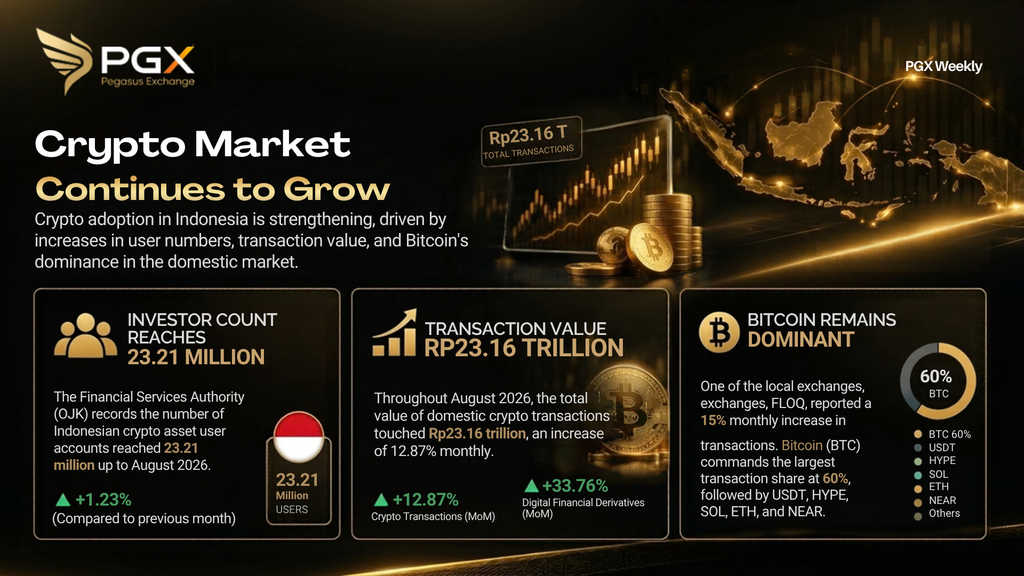
According to the latest data released by the Financial Services Authority (OJK), the number of digital asset consumer accounts in Indonesia reached 23.21 million accounts as of August 2026, representing a 1.23% month-on-month increase from July 2026.
The growth highlights continued public interest in digital assets despite fluctuations in global financial markets. More importantly, it reflects increasing familiarity with blockchain technology and digital financial products among Indonesian consumers. As digital finance becomes more integrated into everyday financial activities, crypto assets are increasingly viewed as part of a broader financial ecosystem rather than a niche investment category.
The positive trend is also supported by Indonesia’s evolving regulatory framework, which continues to provide greater certainty for market participants and industry stakeholders. OJK has continued strengthening oversight of digital financial assets while promoting innovation and market integrity through a regulated ecosystem.
Transaction Activity Shows Strong Recovery
Beyond user growth, market activity also experienced a notable increase.
OJK reported that the total value of crypto asset transactions in Indonesia reached Rp23.16 trillion during August 2026, increasing 12.87% compared to the previous month. At the same time, digital asset derivative transactions recorded even stronger growth, rising 33.76% month-on-month to Rp4.56 trillion.
These figures suggest that market participation remains active despite periods of price volatility. Growing transaction volumes often indicate increasing confidence among market participants and demonstrate that digital assets continue to attract attention as an emerging asset class.
The growth in derivative products is particularly noteworthy, as it signals increasing market sophistication and the gradual development of supporting infrastructure within Indonesia’s digital asset ecosystem.
Bitcoin Remains the Market Leader
Despite the rapid expansion of the broader crypto market, Bitcoin continues to maintain its position as the dominant digital asset globally and within Indonesia.
Many investors still view Bitcoin as the primary gateway into the digital asset ecosystem due to its liquidity, market capitalization, security track record, and growing institutional acceptance worldwide.
As adoption increases, Bitcoin continues to play a central role in shaping overall market sentiment and often serves as a benchmark for the performance of the broader digital asset market.
Global Markets Focus on Macroeconomic Signals
While Indonesia’s domestic crypto market shows encouraging growth, global market sentiment continues to be influenced by developments in the United States economy.
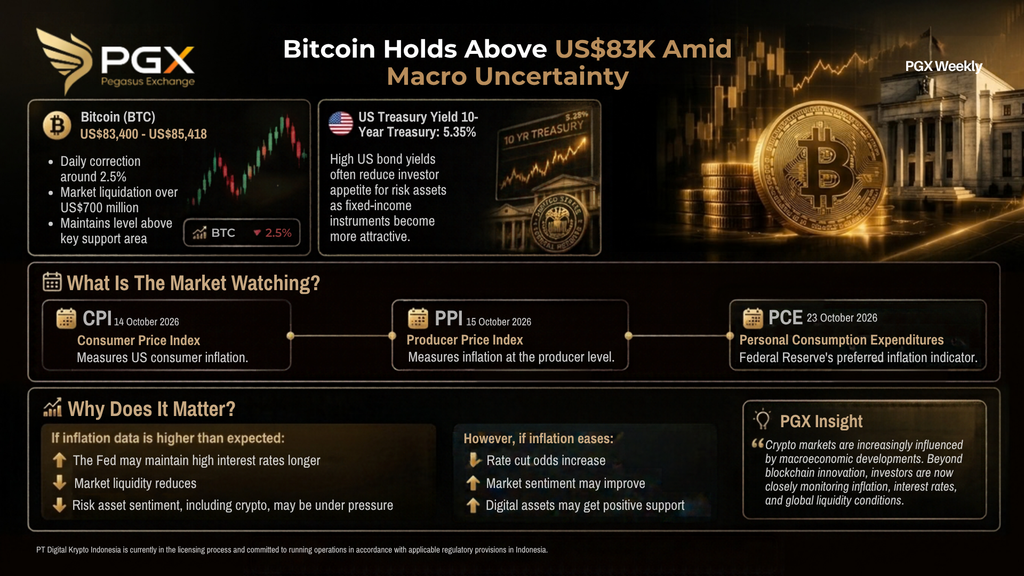
Bitcoin has recently traded in the range of approximately US83,400–US85,418, while investors closely monitor movements in U.S. Treasury yields and expectations regarding future Federal Reserve policy decisions.
One of the key indicators attracting market attention is the 10-Year U.S. Treasury Yield, which has climbed above 5%. Higher bond yields generally make fixed-income investments more attractive and can reduce liquidity flowing into risk assets such as equities, technology stocks, and digital assets.
As a result, market participants are carefully watching several major economic releases scheduled throughout October, including:
- Consumer Price Index (CPI) – 14 October
- Producer Price Index (PPI) – 15 October
- Personal Consumption Expenditures (PCE) – 29 October
These indicators will provide important insights into inflation trends and may influence expectations regarding future interest rate decisions by the Federal Reserve.
Why Does This Matter for Crypto?
The relationship between digital assets and macroeconomic conditions has become increasingly significant over the past several years.
When inflation remains elevated, central banks may maintain higher interest rates for longer periods. This can tighten liquidity conditions and reduce investor appetite for higher-risk assets.
Conversely, signs of moderating inflation could increase expectations for a more accommodative monetary policy environment, potentially supporting risk assets, including cryptocurrencies.
As institutional participation in digital assets continues to grow, crypto markets are becoming more interconnected with traditional financial markets. This means that macroeconomic developments, monetary policy decisions, and global liquidity conditions now play a larger role in shaping digital asset market performance.
Indonesia’s Digital Asset Industry Continues to Mature
Beyond user growth and transaction volumes, another important development is the ongoing maturation of Indonesia’s digital asset ecosystem.
OJK has reported continued progress in licensing, supervision, and market infrastructure development. The regulator has also emphasized future opportunities involving areas such as:
- Real World Asset (RWA) tokenization
- Stablecoin development
- Digital asset custody services
- Digital asset-based fund management
- Expansion of digital financial infrastructure
These developments indicate that the future of digital assets extends beyond trading activity alone. Blockchain technology is increasingly being explored as infrastructure capable of supporting broader financial innovation and economic transformation.
PGX Insight
Indonesia’s crypto industry continues to demonstrate positive momentum through increasing user participation, growing transaction activity, and stronger regulatory foundations.
At the same time, global macroeconomic developments remain an important factor influencing market sentiment and capital flows.
As the industry evolves, success will not be measured solely by price performance or transaction volume, but also by the strength of regulation, infrastructure, institutional participation, and the ability to build a sustainable digital financial ecosystem for the future.
Learn First. Invest Smarter.